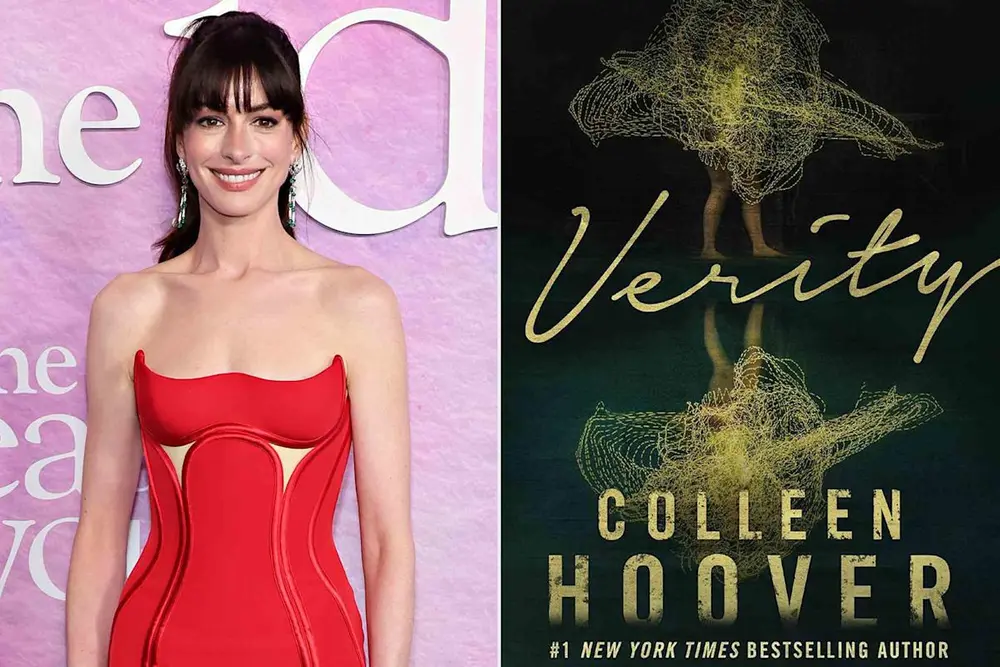
Verity, Amazon MGM's adaptation of Colleen Hoover's darkest bestseller, opens October 2 after being bumped from a May date and then briefly a September one, a scheduling history that reveals more about how studios are now handling Hoover's catalog than any single trailer could.
A movie moving its release date once is routine. A movie moving it twice, in the same calendar year, while starring an Oscar winner, is the kind of pattern that's usually worth asking questions about. Verity has done exactly that, and the reasoning behind each shift tracks a studio visibly recalculating how much a Colleen Hoover name is actually worth on a given weekend.
Where the date actually landed, and where it didn't start
Directed by Michael Showalter and led by Anne Hathaway, Dakota Johnson, and Josh Hartnett, Verity was originally set for a May 15 release, positioned deliberately as counterprogramming against male-skewing tentpoles landing the same month, including The Mandalorian and Grogu and Avengers: Doomsday. That date got scrapped in favor of a spot in the Halloween season instead, and the film has now settled into October 2, opening the same weekend as an untitled Tom Cruise thriller from Alejandro G. Iñárritu.
Why "Halloween season" wasn't a random landing spot
Moving a psychological thriller into the run-up to Halloween isn't a subtle decision, it's a studio betting that genre timing matters more than avoiding a crowded weekend. Verity follows struggling writer Lowen Ashleigh, hired to ghostwrite the remaining books in a bestselling author's series, only to uncover disturbing handwritten confessions that unravel everything she thought she knew about the family she's living with. That's a considerably darker premise than the heartbreak-driven romance that defined Hoover's previous adaptations, and putting it in spooky-season territory instead of counterprogramming a summer blockbuster slate reads like Amazon MGM deciding the story's tone, not the calendar gap, should drive the release strategy.
The pattern this fits inside
Verity is the fourth major theatrical Hoover adaptation in roughly two years, following It Ends with Us, Regretting You, and Reminders of Him, with those films collectively pulling in well over half a billion dollars at the box office. That kind of track record changes how a studio schedules a follow-up. Early Hoover adaptations got treated like counterprogramming experiments, betting on an underserved audience showing up against bigger releases. A fourth entry with two Oscar-caliber leads gets treated differently, as an event capable of holding its own turf rather than dodging someone else's.
What makes this one different from the rest of Hoover's catalog
Unlike the romance-forward tone of It Ends with Us or Reminders of Him, Verity is being marketed as a gothic, psychosexual thriller, closer in spirit to The Housemaid, a literary adaptation that pulled in close to $400 million globally, than to anything else currently carrying Hoover's name. That's a deliberate swing. If Verity performs the way industry analysts are projecting, it becomes the proof of concept for treating Hoover's darker material as its own separate lane, distinct from the tearjerker branding that's defined the adaptations so far, rather than folding everything she's written into one interchangeable marketing bucket.
What's actually riding on October 2
With five Hathaway-led releases hitting theaters and streaming in 2026 alone, Verity isn't just another Hoover adaptation, it's a test of whether a starrier, more prestige-leaning cast can push this particular subgenre somewhere the earlier films didn't reach. If it works, expect studios to keep raiding Hoover's backlist for its more unsettling entries instead of just chasing the formula that made It Ends with Us a hit. If it doesn't, the two scheduling reversals it took to get here might end up being remembered as the more interesting story than the film itself.