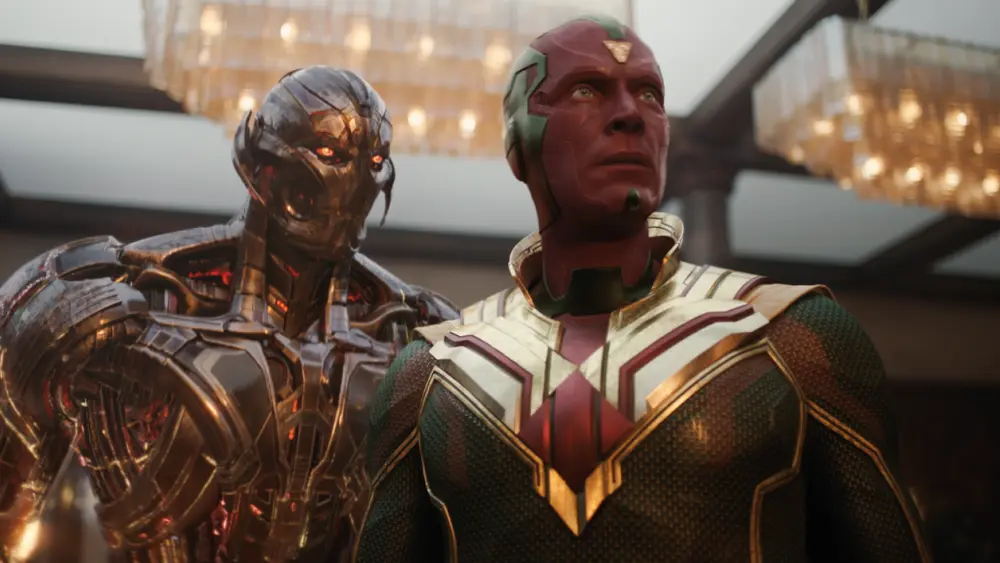
VisionQuest premieres October 14 on Disney+, bringing Paul Bettany back as Vision and James Spader back as Ultron to close out a loose trilogy that began with WandaVision in 2021 and continued through Agatha All Along, five years and one franchise reshuffle later.
WandaVision wasn't built to spawn a trilogy. It was Marvel's first Disney+ series, a self-contained, genre-bending grief story that happened to end on a cliffhanger nobody necessarily expected to pay off this literally. Five years and one spinoff later, Marvel is treating that cliffhanger as the start of something it never originally called a saga, and VisionQuest is where that retroactive trilogy finally closes.
What's actually premiering
The eight-episode series debuts October 14, with Paul Bettany back as the synthetic "White Vision" left behind after WandaVision's finale, trying to recover both his memory and whatever counts as humanity for an android built from a dead Avenger's code. James Spader returns as Ultron, Vision's creator, nine years after Avengers: Age of Ultron, setting up exactly the kind of creator-versus-creation tension that's been part of Vision's story since his introduction. Terry Matalas, best known for steering Star Trek: Picard to a well-reviewed finale, serves as showrunner, which on its own tells you Marvel wanted someone experienced specifically in closing out long-running character arcs rather than opening new ones.
Why calling this a "trilogy" is doing more work than it looks like
WandaVision and Agatha All Along weren't conceived together, they share a universe and some supporting cast, but Agatha All Along was originally developed under a different title focused on Kathryn Hahn's breakout character, not as a deliberate middle chapter. Branding VisionQuest as the third part of a trilogy retroactively reshapes how both earlier shows get read, turning what was a surprise hit followed by a spinoff into something that looks, in hindsight, like a planned three-act structure. That's a useful narrative to tell an audience, even if the actual production history was messier than the marketing now suggests.
The format choice that's easy to miss
Each of VisionQuest's eight episodes is reportedly built to emulate a different film genre, the same structural gimmick that made WandaVision's early episodes, its sitcom pastiches in particular, the thing everyone talked about before the finale even aired. Returning to that device isn't just nostalgia, it's a signal that Marvel sees genre-shifting as Vision's storytelling language specifically, tied to a character whose entire arc is about piecing together an identity from fragments that don't naturally fit together.
Where this leaves the MCU's TV strategy
VisionQuest lands in a year already packed with Marvel output, Daredevil: Born Again wrapped earlier in 2026, The Punisher: One Last Kill just hit Disney+, and Spider-Man: Brand New Day and Avengers: Doomsday are both still ahead before the year's out. Closing the WandaVision trilogy now, right in the middle of that density, suggests Marvel wants Vision's story fully resolved before Doomsday potentially reshuffles the board again. Whether VisionQuest sticks the landing on a character study that started as a grief metaphor and is ending as a legacy-sequel-style conclusion is the real test, not whether Marvel can still open a show with a clever genre pastiche.