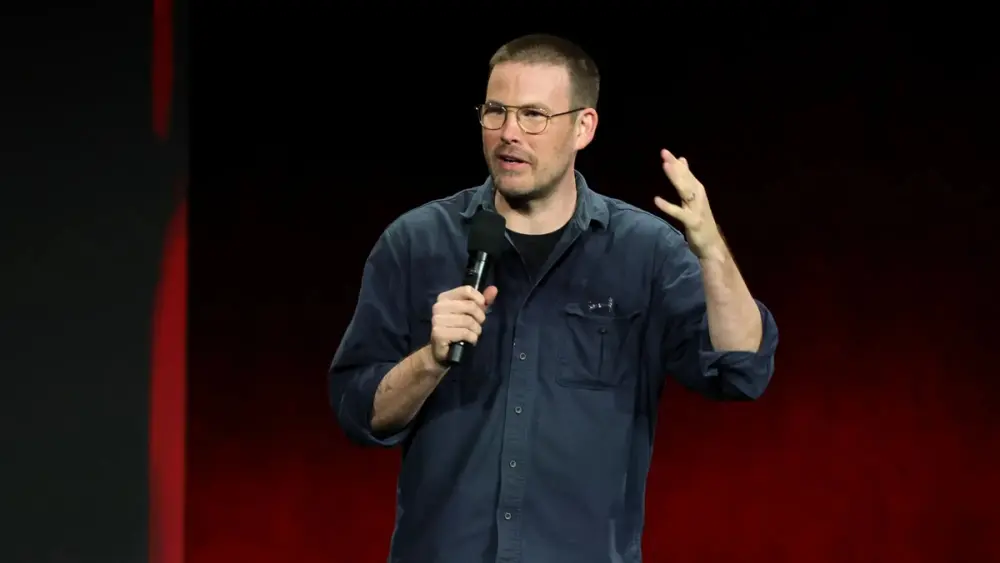
Every Resident Evil movie that's come before this one has leaned on the same crutch: put a familiar face from the games on screen and let nostalgia do the heavy lifting. Zach Cregger's reboot throws that playbook out entirely.
There's no Leon Kennedy. No Jill Valentine. No returning cast from Paul W.S. Anderson's six-film run or the Welcome to Raccoon City reboot that came before this one. Instead, the entire movie rides on Bryan, a medical delivery courier played by Austin Abrams, who has the profound misfortune of making a supply run to Raccoon City General Hospital on exactly the wrong night.
An Original Story Set Inside a Night the Games Already Told
Here's where it gets interesting for anyone who's actually played the games. According to Cregger, the film unfolds during the same night as Resident Evil 2, just from a completely different angle. Bryan isn't a cop, an agent, or a bioweapons specialist. He's an ordinary guy who gets pulled into the outbreak from the outside, which puts him a lot closer to how it actually feels to play the games for the first time than any of the previous films managed.
One early reaction from a test screening compared the tone to a horror version of Mad Max: Fury Road, all momentum and dread with barely any room to breathe. Cregger has described the approach directly through the lens of a longtime player: that specific moment in every Resident Evil game where you're standing in a dark doorway with one bullet left, and you have to force yourself to move forward anyway. That's the feeling he's built the entire film around.
Why Skipping the Mascots Is the Bold Part
Cutting Leon and Jill isn't a small decision. Those characters are the reason a lot of casual moviegoers know Resident Evil exists in the first place, and previous films used them as a built-in audience hook. Betting a studio franchise on an original protagonist nobody's met before is a real risk, especially for a series that's already survived one reboot.
But it's also the only way to actually recreate what made the early games terrifying. Leon and Jill are trained professionals. Bryan isn't. Stripping the story down to someone with no combat training and no plan beyond staying alive puts the audience back in the position the games were originally designed to create: outmatched, underprepared, and completely alone.
The Director Behind the Wheel
Cregger isn't walking into this cold. Barbarian turned a five-million-dollar production into a genuine word-of-mouth hit, and Weapons followed it up with an even stranger, more unsettling swing that still connected with both critics and audiences. Two films in, he's built a reputation as one of the few horror directors currently working who can make an original concept feel like an event.
He's also been upfront that he hasn't actually watched the previous Resident Evil movies, which tracks with a filmmaker more interested in translating the feeling of the games than referencing the franchise's own screen history. Whether that's a strength or a blind spot depends entirely on how the finished film plays.
Resident Evil hits theaters everywhere on September 18, running 90 minutes, with Zach Cherry, Kali Reis, and Paul Walter Hauser rounding out the cast as Umbrella scientists caught in the same outbreak as Bryan. For a franchise that's leaned on familiar faces for over two decades, this is the first time in a long while that Resident Evil is betting on a stranger instead.